RAG & AI Knowledge Assistants

Build Retrieval-Augmented Generation (RAG) systems that answer questions from your private documents with accurate, citation-backed responses — no hallucinations.

Overview

What You Get

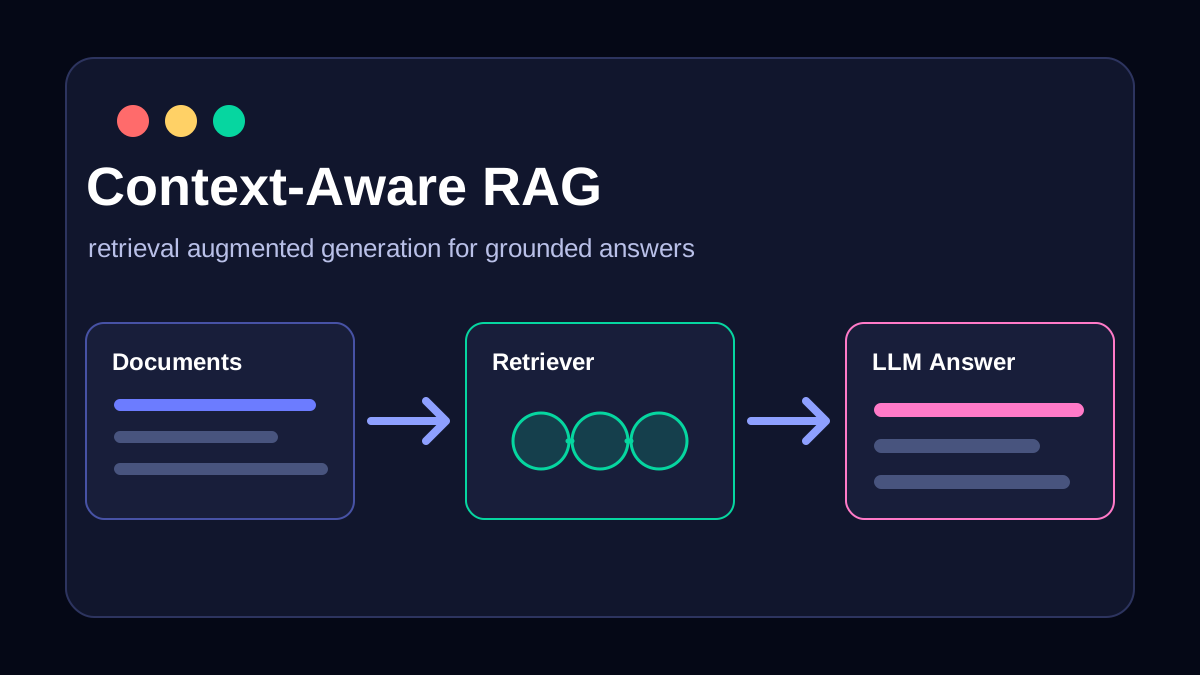
Standard LLMs make things up. RAG systems ground every response in your actual documents, giving users accurate information they can trust and verify. I build end-to-end RAG pipelines from ingestion and chunking through retrieval, reranking, and final generation.

Process

How I Work

  1. 1

    Document Audit

    Inventory your data sources: PDFs, databases, APIs, wikis — and identify the query types to optimize for.

  2. 2

    Ingestion Pipeline

    Parse, chunk, and embed documents using optimized strategies (semantic chunking, parent-child, late chunking).

  3. 3

    Retrieval & Reranking

    Combine vector similarity search with BM25 or cross-encoder reranking for maximum precision.

  4. 4

    Generation Layer

    Prompt-engineer the LLM to answer only from retrieved context, include citations, and gracefully handle out-of-scope queries.

  5. 5

    Evaluation & Tuning

    Measure retrieval precision, answer faithfulness, and latency — then tune until metrics hit production targets.

Benefits

Why Choose This Service

  • Answers grounded in your data — not LLM guesswork
  • Cites exact source passages users can verify
  • Works on private, proprietary documents that never leave your infrastructure
  • Continuously improvable as your document corpus grows
  • Reduces time-to-answer from hours to seconds for knowledge workers

Deliverables

What You Receive

  • End-to-end RAG pipeline codebase
  • Document ingestion and re-indexing scripts
  • Query API with streaming support
  • Evaluation benchmark with accuracy metrics
  • Infrastructure-as-code for deployment

FAQ

Common Questions

What is a RAG system?

Retrieval-Augmented Generation combines search over your private documents with a language model. The model answers only from the passages it retrieves and cites them, so responses can be verified.

What kinds of documents can it handle?

PDFs, databases, APIs, and wikis. The first step is a document audit to inventory your sources and the types of questions people ask.

Do my documents have to leave my infrastructure?

No. The pipeline can run on your own infrastructure, and the deliverables include infrastructure-as-code for deploying it there.

How do you measure answer quality?

Retrieval precision, answer faithfulness, and latency are measured against an evaluation benchmark, and the pipeline is tuned until those targets are met. The benchmark is handed over with the code.

Which vector databases do you work with?

Pinecone, ChromaDB, Weaviate, and PostgreSQL with pgvector, chosen to fit your existing stack.